

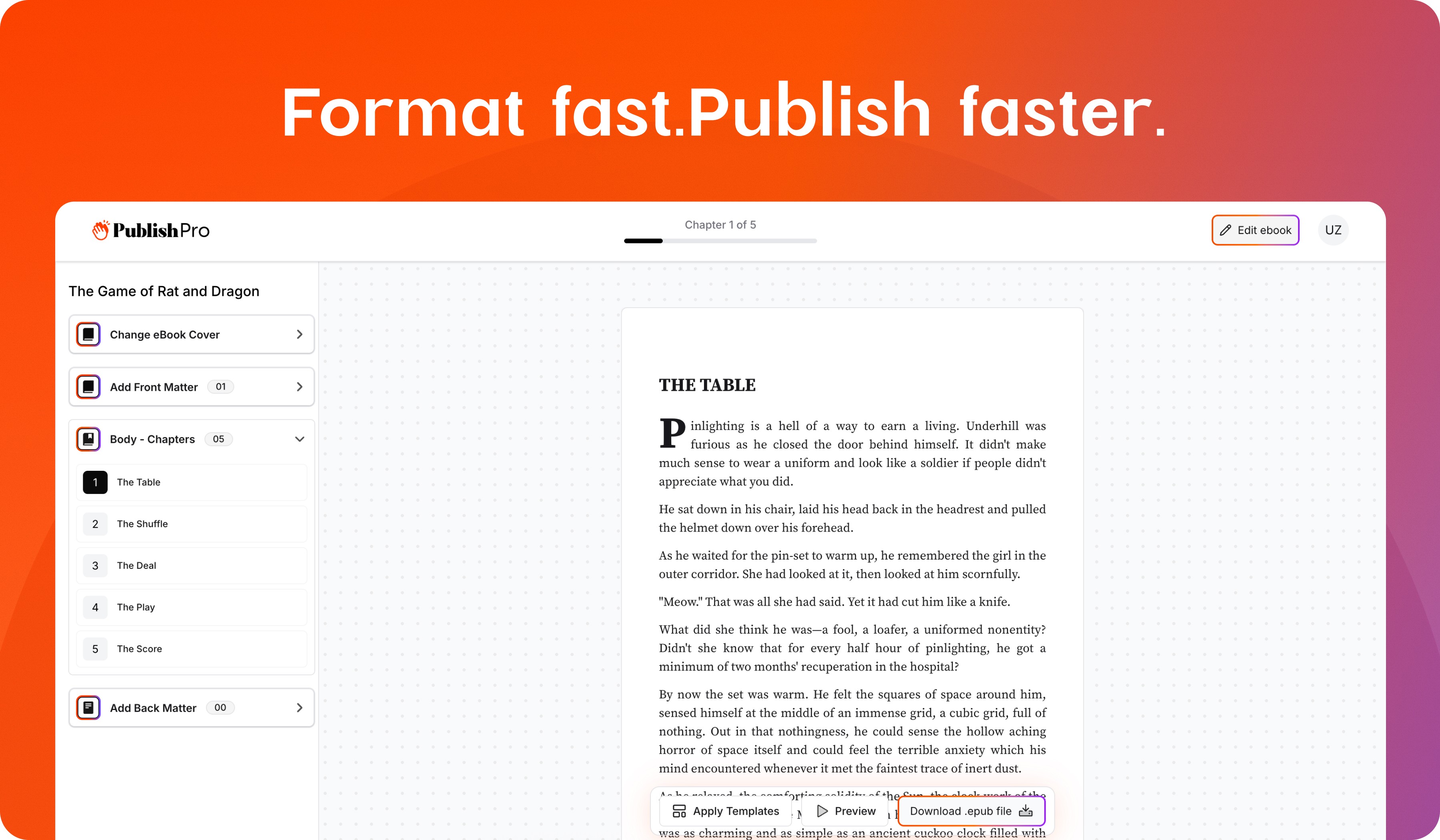
From Prototype to Real Product: How We Built PublishPro to Solve a Real Self Publishers Pain Point
Why real products demand more than prototypes—and how PixelGrid turns ideas into products people actually use.

Umair Zulfiqar
Co-founder
Part 1: The Real Problem No One Talks About in Self-Publishing
Writing a book is hard. But for most self-publishing authors, the real struggle starts after the last chapter is written.
Formatting.
Margins breaking across chapters.
Fonts behaving differently on Kindle.
Paperback rules that feel impossible to follow.
Hours wasted fixing layouts instead of publishing.
Most tools either:
Feel too technical
Require manual work
Or break when the document gets complex
That’s the gap PublishPro was built to solve.
“Great products don’t invent problems. They remove existing pain.”
The rich text element allows you to create and format headings, paragraphs, blockquotes, images, and video all in one place instead of having to add and format them individually. Just double-click and easily create content.
Why PublishPro Exists
PublishPro helps self-publishing authors format their books correctly and confidently—without fighting KDP rules, tools, or file formats.
The goal was simple:
Upload your manuscript
Apply the right formatting rules
Export a clean, compliant ebook or paperback
No guesswork. No trial and error.
Just clarity.
Part 2: From Fast Prototype to Production-Ready Product
Like many modern products, PublishPro didn’t start with heavy engineering.
It started with speed and validation.
Step 1: Rapid Prototyping to Validate the Idea
We began by:
Using Vercel v0 for quick UI prototyping
Testing flows with real author use cases
Validating if the problem was real (it was)
This phase helped us answer one question fast:
👉 Will authors actually use this? Design is not just what it looks like and feels like. Design is how it works.
Step 2: When Prototypes Aren’t Enough
Formatting books is not a “simple UI problem.”
It’s a rule-based, logic-heavy system.
As complexity grew:
Different trim sizes
KDP paperback constraints
EPUB structure rules
Edge cases in real manuscripts
We hit the point where no low-code or vibe-coded solution could scale.
That’s when we shifted to custom engineering.
Step 3: Building the Core Engine
To handle real-world complexity, we built:
A Python-based formatting engine
Rule-driven logic for KDP compliance
Smart parsing of DOC/DOCX files
Reliable EPUB and paperback outputs
The frontend was rebuilt using:
React + Next.js for performance and scalability
Clean UX for non-technical authors
This wasn’t about speed anymore.
It was about correctness, reliability, and trust.
Step 4: Brand, UX, and Trust
A serious product needs a serious brand.
So we handled:
Logo and brand identity
Full UI/UX design in Figma
Design system for consistency
Website built in Framer
Because tools that deal with creators’ work must feel:
Calm
Clear
Reliable
Part 3: From Internal Build to Live Product
PublishPro is not a concept.
It’s not a demo.
It’s not a case study slide.
Real users are using it.
Real books are being formatted.
Real problems are being solved.
And that’s the difference.
What PublishPro Represents for PixelGrid
PublishPro isn’t just a product.
It’s proof of how PixelGrid works.
We don’t just design.
We don’t just prototype.
We don’t stop at MVPs.
We take end-to-end ownership:
Idea → Prototype → Engineering → Brand → Launch → Real users
Whether it’s an AI tool, SaaS platform, or automation system—
we build products that are meant to live, scale, and last.
www.publishpro.app
[ what's next ]